Free Printable Blood Sugar Log (14-Day Glucose Chart)
Whether you've just been diagnosed with diabetes or prediabetes, or your doctor simply wants a closer look at your glucose, you'll probably be asked to bring a record of your readings. A single number rarely tells the story. A log of readings across meals and days shows patterns your care team can act on.
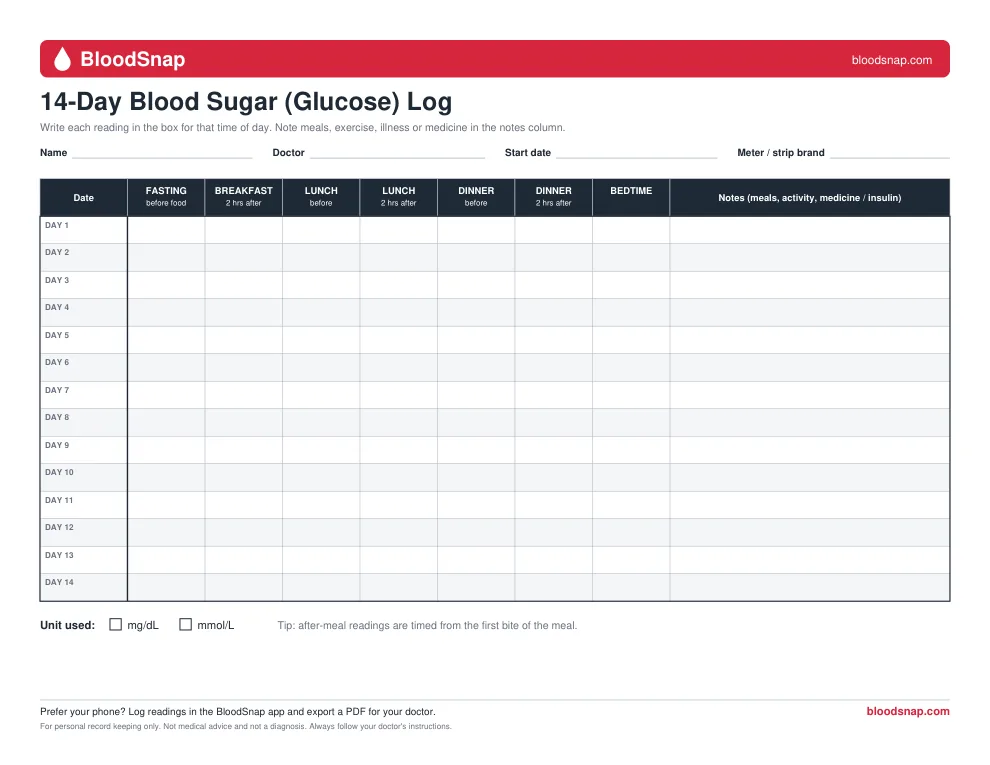
Our free printable blood sugar log gives you a clear grid for 14 days: fasting, before and two hours after meals, and bedtime, with a notes column for food, activity and medicine.
Download the free blood sugar log (PDF)What's inside the free blood sugar log
- Page 1 (landscape): 14 days of readings with seven time slots a day: fasting, before and 2 hours after breakfast, lunch and dinner, and bedtime. There is a tick box for mg/dL or mmol/L and a wide notes column.
- Page 2: quick-reference targets in both mg/dL and mmol/L, tips for accurate readings, and what to do if your sugar is low.
You don't need to fill every box. Your doctor or diabetes educator will tell you which times matter for your situation, depending on your treatment.
Download the free blood sugar log (PDF)Why track your blood sugar
A log helps you and your care team see how food, activity, stress, illness and medicines affect your glucose. It can show, for example, that your fasting numbers are fine but your readings after dinner run high, which points to a very different fix than a general “your sugar is high.” Your blood sugar log also complements lab tests such as A1C. The lab test gives a longer-term average, while the log shows the day-to-day ups and downs behind it.
How to test your blood sugar accurately
- Wash and dry your hands first. Sugary residue on your fingers can give a false high.
- Use a fresh test strip and check the expiry date.
- Prick the side of your fingertip, which is usually less painful than the pad.
- Test at consistent times each day so patterns are easy to spot.
- Follow your meter's instructions and your care team's advice for how often to test.
How to fill in the log
- Write the date in the first column.
- Record your reading in the box for that moment. Time the “after meal” readings from the first bite of the meal.
- Tick the unit your meter uses: mg/dL or mmol/L. Mixing units is a common mistake, so check your meter once and stick with it.
- In the notes column, jot down what you ate, any exercise, illness or stress, and any medicine or insulin you took.
Converting units: to convert mg/dL to mmol/L, divide by 18. For example, 126 mg/dL is about 7.0 mmol/L.
Blood sugar targets: what are the usual numbers?
Targets are individual, so always follow your doctor's advice. As a general reference, based on American Diabetes Association guidance for non-pregnant adults:
| Moment | mg/dL | mmol/L |
|---|---|---|
| Typical fasting level without diabetes | 70–99 | 3.9–5.5 |
| Before meals: common target for adults with diabetes | 80–130 | 4.4–7.2 |
| 1–2 hours after the start of a meal: common target | under 180 | under 10.0 |
| Low blood sugar (hypoglycemia) | below 70 | below 3.9 |
A home meter reading is used to manage your blood sugar, not to diagnose diabetes. Diagnosis is made with laboratory tests ordered by your doctor.
What to do if your blood sugar is low
Low blood sugar (below 70 mg/dL or 3.9 mmol/L) can make you shaky, sweaty, hungry, dizzy or confused. A common first step is to have 15 grams of fast-acting carbohydrate, such as glucose tablets or half a cup of juice, and recheck in 15 minutes. Follow the plan your doctor has given you. Call emergency services if the person is confused, can't swallow or is unconscious. Tell your care team about repeated lows.
What your doctor looks for in your log
Rather than every single number, your care team looks for patterns:
- Are fasting readings consistently above target?
- Do readings jump after particular meals?
- Are there lows at certain times, such as before dinner or overnight?
- Does exercise, illness or stress change the numbers?
Your notes column is what turns the numbers into answers, so use it.
Paper log or phone app?
A paper log is great for a two-week check and costs nothing. If you test several times a day for the long term, though, writing everything down gets tiring.
BloodSnap lets you log blood sugar readings on your phone, snap a photo of your meter screen instead of typing, see your readings as a chart, set reminders, and export a PDF report for your doctor. It also tracks blood pressure, weight and pills.
Frequently asked questions
Related: Free blood pressure log | Free medication log | Free weight loss tracker